
Spine
Anatomy of the spine
The spine forms the bony axis of the human body, supporting it and connecting the head, chest, arms, legs and pelvis. The segmental structure of its 24 vertebrae gives us mobility. A healthy spine enables rotational movements, lateral bending, and forward and backward bending. Three flexible curves or arches give it its typical S-shaped curvature. It is an ingenious combination of stability and mobility and is a complex organ that gives us, as the most highly developed species on Earth, a dynamic balance.
A vertebra consists of a compact but, due to its structural design, very elastic vertebral body and a vertebral arch extending to the rear, which has two lateral transverse processes and the spinous process protruding to the rear. Between the vertebral arch and the vertebral body is the spinal canal, which contains the spinal cord. A distinction is made between the anterior column, in which the vertebral bodies – which are lined up like a chain – are connected in the anterior portion by the intervertebral discs (except between the 1st and 2nd cervical vertebrae), and the posterior column, which is connected by the so-called intervertebral joints (facet joints). The facet joints are located in pairs between the transverse processes and the vertebral body. Their joint surfaces are covered by a cartilaginous sliding layer. The facet joints are embedded in a joint capsule permeated by blood and nerve tissue.
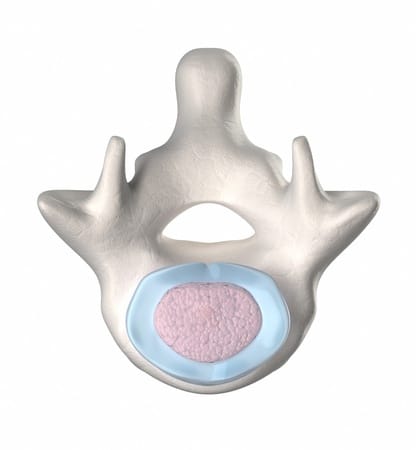
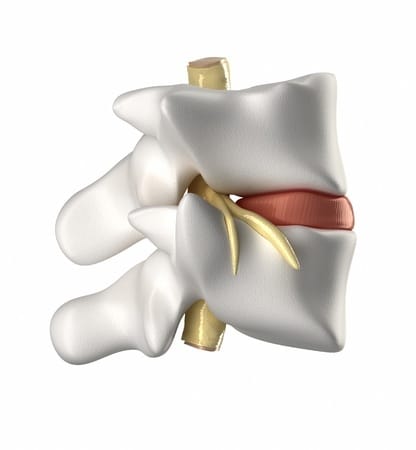
Anatomie der Bandscheibe (Discus intervertebralis)
Between the segmentally arranged vertebral bodies, from the second cervical vertebra to the sacrum, there are 23 intervertebral discs, which act as a kind of buffer between the vertebral bodies. The intervertebral disc consists of an outer fibrous ring (annulus fibrosus) and a central gelatinous core (nucleus pulposus). The fibrocartilaginous outer zone of the fibrous ring radiates into the end plates of the vertebral bodies. The central and peripheral extensions of the fibrous ring are anchored in the ligaments. This complex and elastic connection unit consisting of ligaments, intervertebral discs and vertebral bodies forms the front column of the spine. The gelatinous core is embedded inside the fibrous ring. It consists of 80–85% water and can change its internal tension by absorbing fluid. Under short-term stress, the intervertebral disc acts as a pressure-elastic, hydrostatic system, similar to a hydraulic press.
References
Schünke, Schulte, Schumacher (2005) Prometheus, Trunk Wall, 1. Bones, Ligaments and Joints, Thieme Publishing
Bertagnoli, Yue, McAfee, An (2011) Introduction to motion-preserving spinal surgery