
Spinal canal stenosis
Signs of wear and tear on the spine stimulate the body's self-healing powers. The body responds by building up bone tissue, which is intended to support and stabilise the vertebrae. These bone growths often lead to osteoarthritis of the facet joints and narrowing of the spinal canal and nerve openings (foramina). The result is severe back pain (lumbago), restricted movement and radiating pain (lumbo-ischialgia), which can lead to paralysis in some cases. As with «intermittent claudication» caused by vascular circulatory disorders, this is referred to as «spinal claudication».
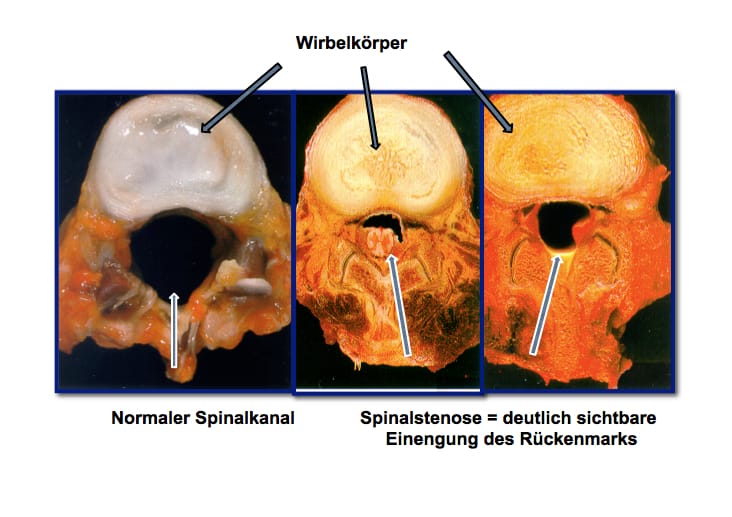
Decompression (relief of pressure on the spinal canal)
If neurological deficits are present, e.g. paralysis, pain, abnormal sensations or limitations in walking distance, surgical relief of the spinal canal (decompression) should be performed. Depending on the severity of the bone spurs, it may be necessary to remove them during this procedure. The removal of these bone spurs can lead to instability in the affected vertebral segments. If instability is present, it should be stabilised. Stabilisation can be achieved using rigid internal support devices (internal fixators), which can, however, accelerate the occurrence of secondary diseases, or using dynamic fixation systems (e.g. Dynesis, CoFlex, DSS, Spine-shape). The advantage of dynamic stabilisation is that it preserves or restores the mobility and function of the spine.
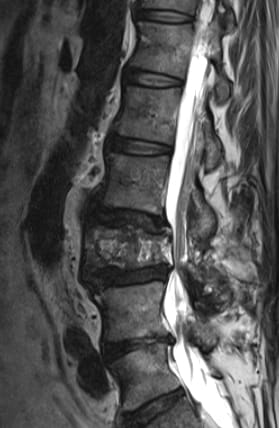
Stenosis of the spinal canal due to destruction of the third lumbar vertebra (Paget's disease) and disc protrusion L4/5. Additional narrowing of the spinal canal due to bony growths on the vertebral arches and joint facets.